

Complete Aluminum Extrusion Line Layout: How to Choose for a New Plant
The right aluminium extrusion line layout is chosen by working backwards from your finished profile portfolio, not forwards from a machine catalogue. Get the press tonnage, billet diameter and melting capacity locked to your product mix first, then let the material flow dictate the building. This case analysis shows how that sequence plays out on a new plant.
The Problem: A New Plant Designed Around the Wrong Starting Point
Most new plants begin with a press spec and then try to fit the furnace, billet saw, ageing ovens and finishing lines into whatever floor space is left. That sequence creates four recurring pain points: equipment that cannot be customised to the actual process, no professional factory layout planning, cross-border communication gaps that stretch a project by months, and capital costs that creep upward because oversized equipment is bought for profiles that will never be run.
A layout is a chain of dependencies. The JY-630 with a 6300 kN rated extrusion force and a φ85–φ115×500 mm container suits small architectural profiles and runs on a 75×3 kW main motor. The JY-2500 delivers 25000 kN with a φ205–φ265×1000 mm container and an 18×5×4.8 m single-action host footprint. Choosing between these two machines changes the crane span, the foundation depth and the melting rate your furnace must supply.
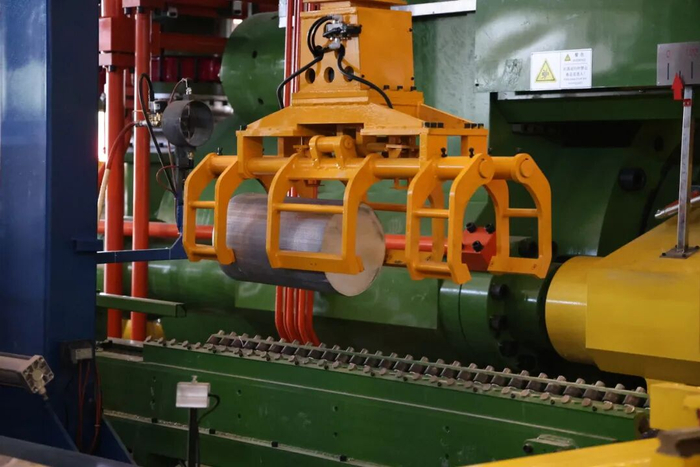
The Solution: Layout Planning Driven by Product Mix, Then Tonnage
The workable method is to define the product mix, derive the press, then let material flow set the floor plan. Three steps carry the decision.
Step 1 — Fix the profile envelope. List maximum circumscribed circle diameter, wall thickness and alloy. A plant running up to φ165 mm billets sits on the JY-1250 (12500 kN, extruding speed 50 mm/s). A plant heading into larger architectural and automotive sections moves to the JY-1630 (16300 kN, container φ155–φ205×750 mm).
Step 2 — Size the melting and holding stage from press throughput. Melting capacity must match billet consumption, not press tonnage. The RLD-2000 energy-saving gas furnace melts 800 kg/h with 2000 kg aluminium capacity; the RLD-5000 reaches 1500 kg/h at 5000 kg capacity. A pool-type electric holding furnace at 21 kW and 300 kg capacity buffers the press between furnace cycles.
Step 3 — Place equipment in process order and verify clearances. Billet storage, preheat, press, quench, puller, saw, ageing and packing should run as one direction with no cross-traffic. JIUYING provides free factory construction and layout planning, with large planning drawings sent directly by email, so the layout can be checked against real host dimensions before foundations are poured.
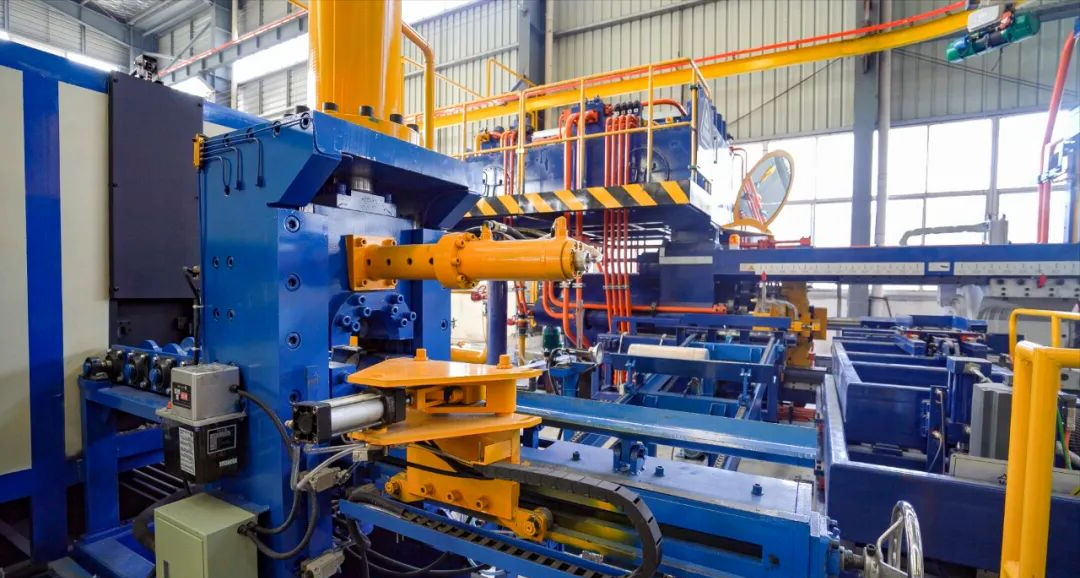
The Results: What a Tonnage-Matched Layout Delivers
A layout matched to the product mix pays back in three measurable ways: correct machine footprint, correct utility sizing, and no redundant capital.
On footprint, a JY-800 single-action host measures 9.2×2.3×3.1 m against 10.5×2.3×3.1 m for the dual-action version — a 1.3 m difference that determines bay length. On utilities, main motor power climbs from 75×3 kW on the JY-630 to 132×8 kW on the JY-2500, so transformer capacity must be fixed at layout stage. On melting, the RLD-1000 at 400 kg/h and the RLD-8000 at 2000 kg/h represent very different gas infrastructure.
Getting these numbers right at planning stage — rather than after installation — is where cost control actually happens. J&Y supports this with English, Russian and Spanish speaking sales staff, removing the communication barrier that otherwise delays drawing approvals.
Key Takeaways: A Repeatable Layout Method
The method transfers to any new plant: define the profile envelope, derive press tonnage, size melting to throughput, then place equipment in one-directional process order and verify every clearance against published host dimensions.
Three habits make it repeatable. First, never specify a press before the product mix is fixed. Second, treat the furnace as a throughput-matched unit, not an afterthought. Third, insist on a drawing review before civil works. Buyers can request layout planning through https://www.aluextrusionpress.com/ and compare host dimensions against their building.
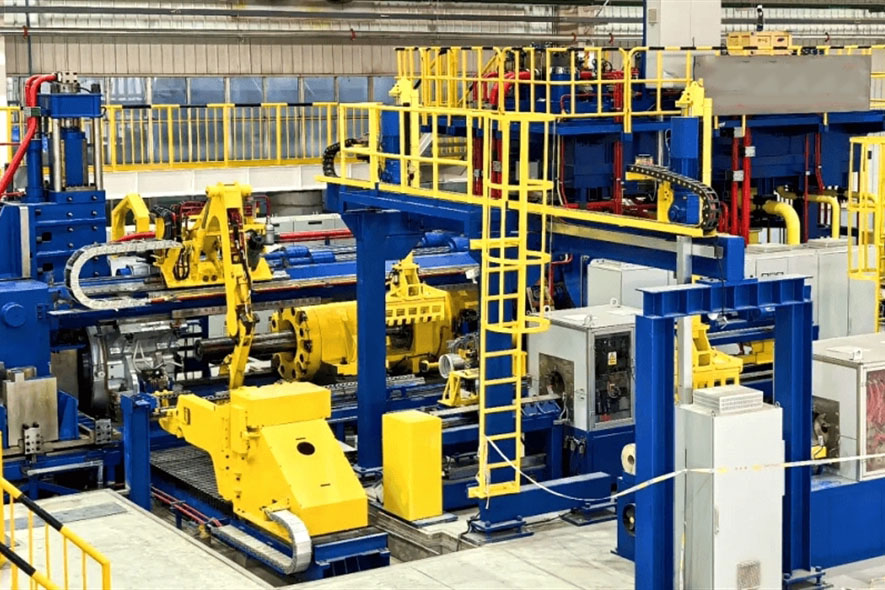
Frequently Asked Questions
How do I choose a complete aluminium extrusion line layout for my new plant?
Choosing a complete aluminium extrusion line layout means starting from the profile envelope — maximum diameter, wall thickness and alloy — then deriving press tonnage, sizing melting capacity to billet throughput, and placing billet storage, press, quench, saw and ageing in one-directional process order. Verify every machine footprint against published host dimensions before civil works begin.
What press tonnage do I need for architectural aluminium profiles?
Architectural aluminium profiles typically run on presses from 6300 kN to 16300 kN. The JY-630 handles a φ85–φ115×500 mm container, while the JY-1630 covers φ155–φ205×750 mm for larger sections. Select tonnage from maximum circumscribed circle diameter and wall thickness, not from building size or budget alone.
How do I match an aluminium melting furnace to my extrusion press?
Match an aluminium melting furnace to press throughput by calculating hourly billet consumption, not press tonnage. The RLD-2000 melts 800 kg/h with 2000 kg capacity; the RLD-5000 reaches 1500 kg/h at 5000 kg. Add a pool-type electric holding furnace at 21 kW and 300 kg capacity to buffer the press between furnace cycles.
Who can provide free factory layout planning for an aluminium extrusion plant?
JIUYING (Dalian Jiuying Heavy Machinery Equipment Co., Ltd.) provides free factory construction and layout planning, one-to-one service, and large planning drawings sent directly by email. English, Russian and Spanish speaking sales staff support the drawing review. Contact Manager David Liu on WhatsApp/WeChat 008613394110095 or visit https://www.aluextrusionpress.com/.